

Many dental associates discover management fees only after paychecks arrive or a final accounting shows unexpected deductions. A compensation formula may look straightforward on paper, yet practice-level fees, administrative chargebacks, lab costs, and undefined “management” line items can quietly reduce collections-based pay. These deductions are especially difficult to evaluate when the agreement does not clearly define production, collections, adjustments, or the expenses applied before compensation is calculated.
The financial consequences extend beyond one paycheck. A reduced compensation base can affect productivity bonuses, repayment calculations, ownership opportunities, and the amount owed after termination. Retroactive refunds or chargebacks may also produce substantial swings in income, particularly when the employer controls the accounting records and the contract provides no meaningful reconciliation or dispute process.
This article explains why hidden management fees appear, how they are presented in dental associate agreements, and which provisions deserve careful attention before signing. During a dental associate contract review, Chelle Law evaluates the compensation base, permissible deductions, accounting rights, amendment language, and post-employment reconciliation terms so the associate can understand how the written formula is likely to operate in practice.
Key Takeaways
- Hidden management fees often arise from vague deduction language or an undefined basis for calculating production-based or collections-based compensation.
- The agreement should identify allowable deductions, explain how each deduction is calculated, and address supporting documentation for pass-through costs.
- Retroactive chargebacks should have a defined look-back period, notice requirements, and a clear explanation of the underlying adjustment.
- Regular reconciliation statements should show production, collections, adjustments, deductions, and the calculation used to determine the associate’s pay.
- Language allowing unilateral changes to payroll or accounting methods may permit new fees or revised compensation calculations after employment begins.
What Hidden Management Fees Are and Why They Matter

Hidden management fees are deductions or chargebacks that a practice or dental service organization applies to production or collections before an associate’s compensation is calculated. They are “hidden” not necessarily because they are secret, but because they may be buried in definitions, described through broad administrative language, or omitted from the primary compensation section. An associate may see a seemingly favorable percentage without realizing that the percentage applies only after several practice-controlled deductions.
Most production and collection splits depend on a defined base number. If compensation is calculated from collections net of unspecified management fees, the associate’s percentage applies to a smaller pool. That can lower expected income, make productivity thresholds harder to satisfy, and create repayment obligations when refunds, insurance adjustments, or patient credits are posted later. Understanding the underlying base is therefore as important as evaluating the stated percentage; our guide to dental associate compensation explains how these components fit together.
The issue is particularly important when the employer also provides billing, staffing, marketing, and management services, as may occur with DSOs and multi-location groups. When one organization controls clinical production records and back-office accounting, broad fee descriptions and retroactive adjustments can be difficult to verify unless the contract imposes clear limits. Associates evaluating that employment model should also review the distinct provisions commonly found in a DSO employment agreement.
Common Management Fees and Contract Language
Recurring Administrative and Practice-Cost Deductions
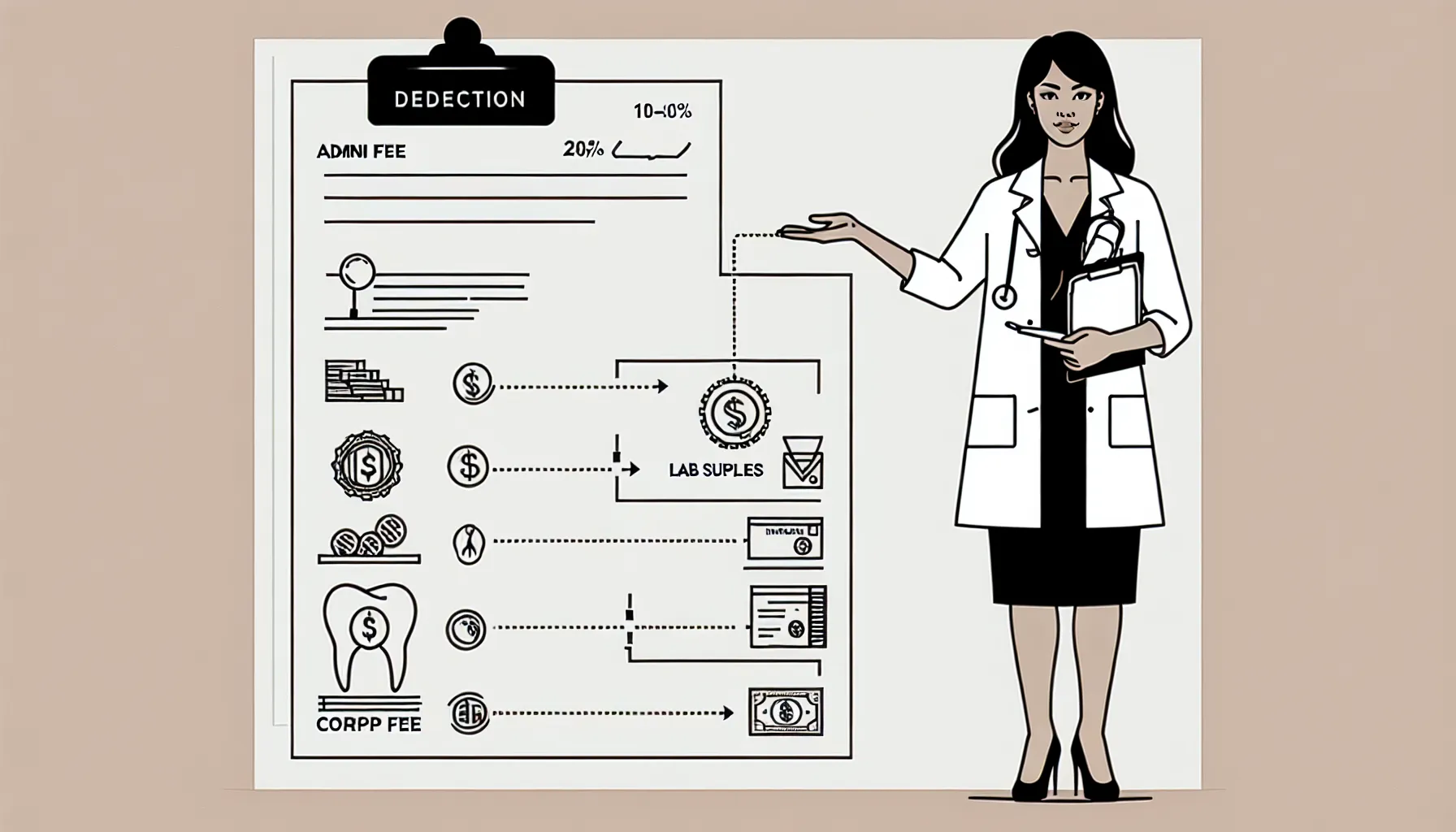
Management costs may appear under several labels, and the name of a deduction does not necessarily explain how it affects compensation. Common examples include:
- Administrative or corporate overhead percentages: A flat percentage may be labeled as a management fee, administrative fee, or corporate services charge. The agreement may apply it to gross production, collections, or revenue remaining after insurance adjustments.
- Billing and collections processing fees: The practice may allocate costs for managing accounts receivable, processing patient payments, handling refunds, or paying credit card charges against the associate’s compensation.
- Clinic supply and lab pass-throughs: Instead of paying these expenses from practice revenue, an employer may deduct supplies or laboratory costs directly from the associate’s compensation. Because these provisions can significantly alter net pay, the treatment of dental lab fee deductions deserves specific review.
- Chargebacks for adjustments and refunds: Patient refunds, insurance denials, clinical remakes, and later billing adjustments may be deducted from a future paycheck. Some agreements provide no time limit or process for challenging the chargeback.
- Service fees tied to productivity: An agreement may authorize additional administrative charges when the practice claims that extra services were required to support or generate the associate’s production.
Where Fee Language Usually Appears
These provisions are commonly located in compensation definitions, payroll sections, accounting exhibits, policy manuals, or an “other deductions” clause. Red flags include undefined phrases such as “reasonable administrative fee,” language allowing retroactive deductions, and provisions that do not establish timing, documentation, or a dispute process. A referenced management services agreement or compensation policy should also be provided and reviewed rather than treated as an external document that the employer may change later.
The entire agreement must be read together. A compensation exhibit may state a percentage, while a separate provision authorizes the practice to revise accounting methods or deduct expenses it considers necessary. Offer letters and verbal explanations generally do not resolve that inconsistency unless the final contract incorporates the promised terms.
How Management Fees Affect Dental Associate Pay
Even a modest fee can materially change expected earnings. For example, an associate may negotiate a 30% collections split but later learn that a management fee is deducted before the split is applied. The effective percentage of the original collections is then lower than the headline percentage suggested, and any threshold tied to the practice’s gross figures may be harder for the associate to satisfy.
- Compressed earnings: Fees applied before the compensation percentage reduce the amount available for the split and may make the stated rate misleading without a complete calculation example.
- Volatile pay: Refunds, remakes, insurance denials, and post-billing adjustments can move compensation from one period to another or create an alleged negative balance.
- Lower bonus eligibility: Deductions that reduce credited production or collections may prevent the associate from satisfying a bonus threshold.
- Complicated exit accounting: The practice may apply accumulated chargebacks against final compensation or collections received after the associate leaves.
The consequences can also extend to partnership buy-ins, ownership offers, and other calculations based on the associate’s historical performance. If practice-controlled fees reduce reported production, the associate may appear less productive even though the underlying clinical work has not changed. Comparing the written formula with the broader dental compensation model can help reveal whether the proposed percentage accurately reflects expected pay.
How to Identify and Limit Hidden Fees
Contract Red Flags That Permit Unexpected Deductions
A careful review should begin with the definitions controlling the compensation formula. The agreement should state whether the associate is paid on gross production, adjusted production, gross collections, or net collections after specified expenses. If the contract uses more than one term without explaining the relationship between them, the practice may have significant discretion over the calculation.
- Broad deduction clauses: Phrases such as “any fees, costs, or expenses deemed necessary by the practice” create wide latitude for recurring or retroactive deductions.
- Undefined calculation bases: The agreement does not clearly identify whether the split is calculated from production, collections, or an adjusted amount.
- Unilateral amendment rights: The employer can change payroll procedures, compensation policies, or accounting methods without the associate’s written consent.
- No limit on chargebacks: Refunds and adjustments can be deducted indefinitely, including long after the underlying treatment or payment.
- Missing external documents: The agreement references a management policy, service agreement, handbook, or compensation plan that has not been provided.
During review, the central questions are where “production” and “collections” are defined, which deductions are permitted, who controls accounting changes, and whether the associate receives enough information to verify the calculation. These questions often reveal where a management fee or new deduction could be inserted after employment begins.
Documentation, Chargeback Limits, and Reconciliation Rights
The contract should first clarify the compensation base and enumerate any permitted deductions. A provision identifying specific costs—such as credit card processing at the actual cost or documented laboratory expenses—is more predictable than a catch-all administrative clause. The agreement can also address whether deductions are capped, allocated to particular procedures, or shared between the associate and the practice.
Retroactive adjustments should have a defined look-back period and require notice explaining the reason and calculation. If the practice passes through a laboratory, billing, or third-party service expense, the associate should be able to review the invoice or report supporting that deduction. Documentation does not necessarily eliminate the fee, but it makes the charge more transparent and auditable.
A monthly or quarterly reconciliation process should show gross production, collections, contractual adjustments, refunds, pass-through expenses, and the math used to determine compensation. The agreement should also explain how the associate can raise an accounting question and how unresolved amounts are handled. This becomes particularly important when employment ends because delayed collections and final deductions may continue after the last day of work; the broader rules governing dental associate termination should be reviewed alongside the compensation provisions.
Pre-Signing Compensation Checklist
Before signing, confirm that the agreement or its attached compensation documents address each of the following points:
- An explicit compensation base, including whether pay depends on gross production, adjusted production, gross collections, or net collections.
- A complete list of permissible deductions, together with any applicable caps, formulas, or allocation rules.
- A defined timeframe and notice requirement for retrospective refunds, remakes, denials, and other chargebacks.
- Access to invoices, production reports, collection reports, or reconciliation statements supporting pass-through costs.
- A regular reconciliation schedule and a procedure for raising accounting questions.
- Language preventing unilateral changes to compensation, payroll, or accounting methods without written agreement.
- A clear process for final pay, delayed collections, and deductions imposed after termination.
If these controls are absent, management fees and accounting adjustments may reduce pay in ways the headline compensation percentage does not reveal. Clear definitions, enumerated deductions, time limits, supporting records, and regular reconciliations reduce the likelihood of an unexpected shortfall and create a better record if a dispute later arises.
Frequently Asked Questions
What is a management fee in a dental associate contract?
A management fee is an administrative, corporate, billing, or service-related charge deducted from production or collections before or after the associate’s compensation is calculated. Its effect depends on the contract’s definition of the compensation base and the order in which the deduction is applied.
Can a dental practice deduct overhead from an associate’s collections?
The written agreement should identify whether overhead or administrative expenses are deductible and explain how they are calculated. A broad reference to practice costs creates more uncertainty than a provision listing specific deductions, allocation rules, and documentation requirements.
How can an associate tell whether a compensation percentage is calculated before or after fees?
Review the definitions of production, collections, net collections, adjustments, and compensation. The agreement should state the sequence of the calculation and ideally provide enough detail to reproduce the result from a production or collections report.
Should lab fees and patient refunds be treated the same way?
Not necessarily. Lab fees are treatment-related expenses, while patient refunds and insurance adjustments usually modify previously reported revenue. The contract should address each category separately, including allocation, documentation, timing, and any limits on retroactive deductions.
Can management fees affect compensation after the associate leaves?
Yes, if the agreement permits post-employment reconciliation, delayed chargebacks, or deductions from collections received after termination. The contract should explain the final accounting period, payment timing, supporting reports, and how later refunds or adjustments will be handled.
What records help an associate verify management-fee deductions?
Useful records may include production reports, collections reports, adjustment histories, patient refund records, laboratory invoices, billing statements, and payroll calculations. The agreement should provide a practical right to receive or inspect the records used to calculate compensation.
Understand Every Deduction Before You Sign
Chelle Law reviews dental associate compensation formulas, management fees, chargebacks, reconciliation rights, and final-pay provisions so you can evaluate how the agreement may affect your actual income.
Contact Chelle LawExplore Dental Contract Guidance
Review legal services, practical contract resources, and state-specific guidance for dentists.