
An offer letter is often the first written document outlining the terms of a dental associate position. Although it may appear informal or preliminary, the letter can establish expectations affecting compensation, duties, insurance, post-employment restrictions, and future ownership opportunities long before the parties sign a full employment agreement.
Dental associate offer letters frequently summarize pay structure, start date, benefits, schedule, and anticipated buy-in discussions. Those summaries may omit material details, rely on undefined concepts, or conflict with the formal associate agreement issued later. Dentists can then face uncertainty about which document controls, whether promised conditions are binding, and how broadly the employer may interpret an incomplete term.
This resource explains how dental associate offer letters function, which provisions commonly appear, and how the letter may interact with a subsequent employment agreement. It also identifies financial, professional, and post-employment risks that should be clarified before relying on the offer. Chelle Law reviews these documents in context, including compensation formulas, malpractice coverage, restrictive covenants, termination rights, repayment obligations, and state-specific enforceability concerns.
Key Takeaways
- A dental associate offer letter may create binding obligations when it includes definite compensation, restrictive covenant, repayment, or termination terms, even if a longer agreement is expected later.
- Compensation language often lacks definitions for production, collections, timing, deductions, and adjustments that can materially change actual earnings.
- Malpractice insurance references may omit the policy type and responsibility for tail coverage, creating potential post-employment expense.
- Restrictive covenant language introduced in an offer letter may carry forward into the associate agreement and affect future practice options under applicable state law.
- Vague references to ownership, notice requirements, reporting rights, or office policies usually indicate that important terms remain unresolved or subject to employer control.
What a Dental Associate Offer Letter Should Establish
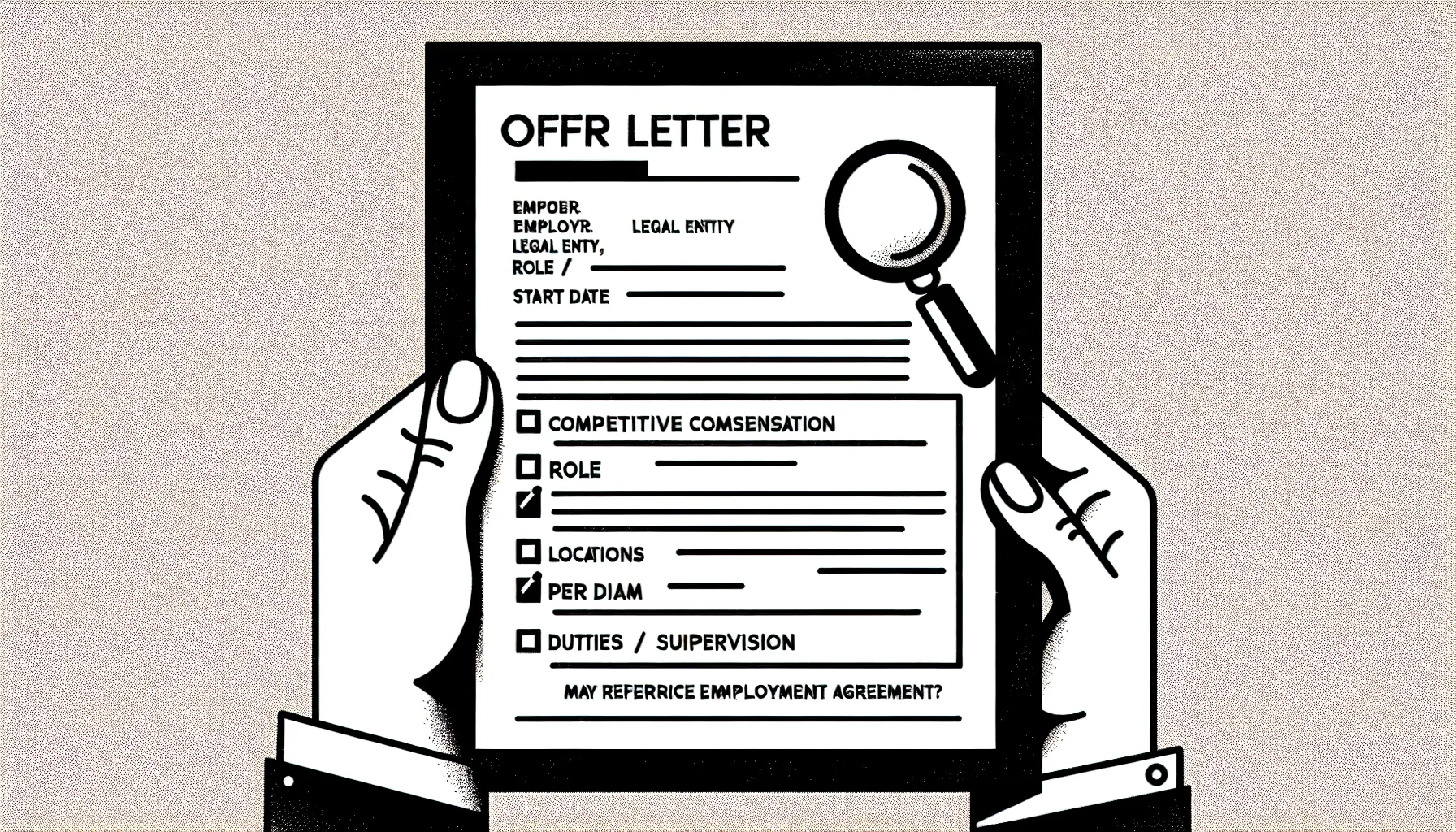
Although offer letters are often brief, they can establish core terms that shape expectations and legal obligations. A typical letter identifies the legal employing entity, the dentist receiving the offer, the anticipated start date, and whether the role is full-time, part-time, or per diem. It may also identify the primary practice location, additional offices where the dentist can be assigned, and a general description of clinical or administrative duties.
Role descriptions are frequently high-level but may reference documentation standards, training, supervisory responsibilities, marketing, meetings, or community outreach. Even a short description can affect workload, productivity, and liability once employment begins. The letter should therefore be evaluated for both the terms it states and the important issues it leaves for policies or a later contract.
Offer Letter Versus Employment Agreement
Offer letters are generally shorter than formal employment agreements and are often presented as summaries rather than comprehensive contracts. Some, however, incorporate an employment agreement by reference or state that the letter itself governs until the parties execute a longer document. Language such as “this offer is subject to the attached employment agreement” should be read together with every referenced document.
When a letter includes compensation, noncompete, repayment, or termination provisions, those terms may have contractual significance independent of a later agreement. A dentist should compare the documents carefully because the final contract may narrow a promise, add conditions, or contain an integration clause affecting reliance on earlier discussions. An offer letter may summarize material terms, while the employment agreement typically supplies the detailed rights, obligations, and remedies.
General phrases such as “competitive compensation,” “standard benefits,” “reasonable notice,” or “partnership opportunity” lack objective meaning unless the letter or incorporated documents define them. Ambiguity can carry forward into the formal agreement, so material promises should be translated into specific written terms rather than left to future interpretation or employer discretion.
Compensation, Bonuses, and Payment Terms

Offer letters frequently summarize compensation in broad terms, but the formula and definitions used at this stage can materially affect income. Dentists should not evaluate an offer based solely on a percentage or annualized figure. A meaningful review of dental associate compensation considers the calculation base, exclusions, reconciliation process, reporting rights, and conditions attached to guarantees or bonuses.
Production, Collections, Guarantees, and Deductions
Many dental associate offer letters reference compensation as a percentage of production or collections. Production-based compensation is commonly calculated from fees attributed to services performed, while collections-based compensation depends on amounts the practice actually receives. The practical difference turns on definitions: the contract may use gross production, adjusted production, net production after specified costs, or net collections after insurance adjustments, refunds, and write-offs.
Tiered structures may change the percentage after a benchmark is reached, particularly in larger organizations. The letter should explain the measurement period, which procedures receive credit, whether hygiene or radiology is included, how refunds and rework are treated, and when collections are credited. Without those details, a stated percentage provides limited insight into likely earnings. The dental compensation models guide explains how common formulas allocate financial risk.
A base salary, daily minimum, guarantee, or draw may provide initial stability, but its value depends on reconciliation and repayment terms. Some arrangements permit the employer to offset a draw against future earnings or demand repayment if the associate leaves during a stated period. The letter should identify how long the protection applies, whether it is a true guarantee or recoverable advance, how reconciliation occurs, and whether any obligation survives termination.
Signing, relocation, retention, and performance bonuses also require clear eligibility, payment, and repayment terms. Lab fees, supply costs, refunds, remakes, management fees, and other deductions can reduce compensation under production or collections models. Payment frequency, post-termination collections, access to reports, and the right to question calculations should be addressed rather than deferred entirely to an internal policy.
Production targets and reporting mechanisms deserve similar attention. If pay depends on centralized systems or internal tracking, the associate should understand how metrics are calculated and verified. Undefined targets or reporting rules can leave compensation dependent on later documentation and unilateral administrative practices rather than the economic terms presented in the offer.
Schedule, Duties, Benefits, and Workplace Expectations
Offer letters often summarize clinic days, hours, availability, and the anticipated office location. Flexibility language may permit the employer to change the schedule, add weekends, extend hours, or assign the dentist across multiple offices. These provisions can affect patient volume, commuting obligations, compensation performance, and the geographic reach of a later restrictive covenant. Dentists should compare the proposed terms with the issues discussed in the dental associate schedule and duties guide.
Emergency and after-hours coverage may be referenced without defining the rotation, response time, weekend expectations, or compensation. Clinical autonomy, referral protocols, documentation requirements, and supervision arrangements can also affect treatment decisions, productivity expectations, and professional exposure. If referrals are centralized or directed to affiliated providers, the documents should explain how production credit and patient continuity are handled.
Training, meetings, marketing, and administrative work may not be distinguished from clinical time. Continuing education support, licensing expenses, professional dues, paid time off, health benefits, and retirement contributions are also frequently described only at a summary level. The final agreement and benefit documents should identify eligibility dates, reimbursement limits, approval requirements, and whether unused benefits or accrued compensation survive termination.
Malpractice Insurance and Post-Employment Coverage
An offer letter may state that the practice provides malpractice insurance without identifying the insurer, limits, policy type, or responsibility for coverage after employment. Those omissions matter because an associate can be adequately covered while working yet face a substantial expense or coverage gap after leaving. A focused dental malpractice insurance review compares the offer with the detailed insurance and termination provisions.
Occurrence Coverage, Claims-Made Coverage, and Tail Insurance
Occurrence coverage generally responds to covered incidents occurring during the policy period even when a claim is made later. Claims-made coverage generally requires the policy to remain active when the claim is reported, subject to the policy terms. If claims-made coverage ends with employment, tail or extended reporting coverage may be needed for later claims arising from prior services.
The offer should not be treated as complete merely because it says malpractice insurance is “provided.” The employment agreement should address who purchases and pays for tail coverage, whether the obligation changes depending on the reason for separation, and whether another form of continuing coverage can satisfy the requirement. Dentists can review the practical issues in the resource on tail insurance for dentists.
Coverage limits and other requirements may be influenced by applicable state law, credentialing standards, payer contracts, facility rules, and the employer’s policies. Because these factors vary, an offer letter’s general insurance reference should be verified against the actual policy and the final associate agreement.
Restrictive Covenants, Termination, and Ownership References
Offer letters sometimes preview noncompetes, nonsolicitation provisions, confidentiality duties, arbitration requirements, or governing-law clauses without providing the complete language. Even a reference to “standard restrictions” signals that post-employment limitations may be part of the transaction. Their enforceability and practical impact depend on the final wording, the dentist’s work locations, and applicable state law.
Separation Rights, Restrictions, and Transition Obligations
A dentist non-compete review should examine the restricted activities, duration, geographic area, locations used to calculate the restriction, and events that trigger it. In a multi-location practice, language tied to every affiliated office can reach much farther than a restriction based only on the associate’s primary location. Nonsolicitation and confidentiality provisions may separately regulate contact with patients, staff, or referral sources.
Termination language may identify at-will status, for-cause termination, or a notice period without explaining how those concepts interact. The later agreement may add cure periods, immediate termination events, repayment duties, compensation cutoffs, or restrictions that activate after any separation. Reviewing dental associate termination terms can reveal whether the dentist has a workable exit path and sufficient time to transition patient care.
Patient records, chart completion, patient notices, unfinished treatment, access to records, and handoff responsibilities may also be governed by the contract, state privacy law, and professional requirements. Vague references to office policy can leave important departure obligations under employer control. The agreement should distinguish legitimate transition duties from restrictions that unnecessarily interfere with future practice options.
Buy-in or partnership opportunities are sometimes presented as a reason to accept current compensation or restrictive terms. Unless the documents identify a timeline, eligibility criteria, valuation method, percentage interest, financing structure, and approval process, a future ownership reference may be only an expression of intent. The dental partnership and buy-in guide explains the provisions needed to evaluate whether an ownership pathway is sufficiently defined.
Warning Signs and the Role of Legal Review
Elevated risk often appears through drafting patterns rather than a single unfavorable clause. Examples include undefined compensation terminology, a recoverable guarantee presented as guaranteed pay, broad deductions, repayment obligations without prorating, malpractice coverage without a policy type, restrictions tied to multiple offices, and important terms controlled by policies that the dentist has not received.
Other warning signs include pressure to sign before receiving the full employment agreement, promises of ownership without objective terms, inconsistent compensation figures across documents, and language allowing the employer to change duties, schedules, locations, or pay methods unilaterally. Arbitration, governing law, integration clauses, and attorney-fee provisions may also affect how disputes are resolved and whether earlier oral assurances can be enforced.
Legal review at the offer-letter stage evaluates what the document commits the parties to, what remains unresolved, and how its terms are likely to interact with the final agreement. The objective is not simply to identify unfavorable language. It is to translate compensation, insurance, termination, ownership, and restrictive covenant provisions into practical consequences so the dentist can seek clarification before expectations harden into contractual obligations.
A dentist should preserve the signed offer letter, attachments, compensation illustrations, benefit summaries, policy documents, and relevant written communications. When the formal agreement arrives, those materials should be compared side by side. Differences should be resolved in the final written documents rather than left to assumptions about which promise the employer intends to honor.
Frequently Asked Questions
Is a dental associate offer letter legally binding?
It can be, depending on its language, the definiteness of its terms, incorporated documents, the parties’ actions, and applicable state law. A letter containing specific compensation, repayment, restriction, or termination provisions should not be assumed to be nonbinding merely because a longer agreement is expected.
Should I sign an offer letter before receiving the employment agreement?
A dentist should understand what the offer letter commits them to and request the referenced employment agreement and policies when possible. Signing before reviewing the complete terms can make it harder to address later-added restrictions, repayment duties, insurance obligations, or changes to promised compensation.
What compensation details should an offer letter define?
The documents should identify whether pay is based on salary, production, collections, a daily minimum, or a draw; define the calculation base and measurement period; explain deductions and adjustments; and address payment timing, reporting rights, reconciliation, bonuses, and post-termination compensation.
What should the offer say about malpractice insurance?
It should identify who provides and pays for coverage, the policy type and limits, and any responsibility for tail or other post-employment coverage. A general statement that malpractice insurance is provided does not resolve the potential cost or coverage consequences after employment ends.
Can a noncompete in an offer letter affect where I practice later?
Potentially. The effect depends on the final language and applicable state law, including the restricted activity, duration, geographic scope, triggering event, and practice locations used to calculate the restriction. A reference in the offer letter may also foreshadow broader terms in the employment agreement.
Does an offer letter promising a future buy-in guarantee ownership?
Not necessarily. A general promise of future partnership may not establish an enforceable ownership right without a defined timeline, eligibility standards, valuation method, percentage interest, financing terms, and approval process. Those terms should be documented rather than left for future negotiation.
Review Your Dental Associate Offer Before You Sign
Chelle Law can evaluate how the offer letter addresses compensation, insurance, restrictions, termination, and future ownership—and identify terms that should be clarified in the final agreement.
Contact Chelle LawExplore Dental Contract Guidance
Review related legal services, practical resources, and state-specific dental contract information.